
The rules and bylaws of the San Diego Pool League are available to you at the links below. The Match Policy and Procedures and the Amended BCA Rules of Play are the rules that the SDPL enforces during regular season play. The Bylaws of the League relate to the officers of the league and the standard operation.
Should you have any questions regarding the rules or bylaws, please contact a board member or plan on attending a regularly scheduled Board Meeting.
The SDPL rules are available for view/download
SDPL Matchplay and BCA Ammended Rules
SDPL Matchplay and BCA Ammended Rules - EFFECTIVE 07/2026
If there are questions regarding rules during play, this is your go-to guide. This edition allows you to go directly to rules by clicking a section in the Table of Contents. If unable to resolve an issue amicably between the two captains, see rule 1.16 – DISPUTES below. Remember, we’re here to have fun, not win at the expense of being unsportsmanlike.
1.0 GENERAL – MATCH PLAY
1.1 MATCH DEFINITION - A match is a San Diego Pool League (SDPL) scheduled competition between 2 sponsored teams.
1.2 MATCH POSTPONEMENT - A 24-hour notice must be given to the opposing team captain and the Vice President if a match must be postponed. If the reason for the match postponement is not acceptable to the opposing team captain, the matter must be referred to the Vice President for an immediate decision on the reason’s validity. The Vice President shall notify the appropriate Board members of the postponement before the scheduled match. The captain postponing shall notify the Statistician within one week when the postponed match is to be played at a time and place mutually agreeable. If the match is not played within the announced time period the Vice President will affix responsibility for the match not being played and recommend punitive action to the Board of Officers.
1.3 END OF SEASON NO-SHOW - During the last two weeks of play; if a team does not show up, no member of that team may play on any team for the next two seasons. If only one member shows up they must inform the Vice President or be disqualified for the next two seasons. Scores via BCAPL App showing forfeits must be submitted by 7:15PM.
1.4 MATCH SCORING AND STANDINGS - Blank score sheets will be available to teams prior to the start of the season as a backup only. Match scoring is to be completed using the BCA Pool League Scoring App. Game statistics and any pool league news will be updated and provided on the pool league website. Team captains are responsible for sharing links/Apps to BCA Pool League, SDPool.org and/or SDPL Facebook page for viewing of match play schedules and team/individual standings with their team members. See Appendix for instructions on using the BCA Pool League Scoring App for match scoring.
1.5 TEAM PRACTICE - Team practice begins at 6:00PM. The home team shall have the pool table for practice for the first half-hour, and the visiting team shall have the table for the second half-hour.
1.6 STARTING TIME -The designated start time for regular weekly match play is 7:00PM local time. The match will begin as close to the designated start time as possible.
1.7 REGISTERED PLAYER - New players may be registered and play on the same night provided $20 BCAPL dues are paid to the Treasurer, except for the last 4 weeks of the season during which time no new players may be registered or play on any team. A registered player may only switch teams during the first half of a team’s scheduled play. All games won or lost prior to the switch will be forfeited by the player and not count for all qualifying tournaments. Any games won or lost by the switching player will not affect the team’s overall scores. A player may only switch teams once per season. A player may switch within his or her division or move to a higher division. A player may move to a lower division with the Board approval.
1.8 NUMBER OF PLAYERS REQUIRED - A match may be played with any number of players between 2 and 7 per team. Any games forfeited because less than 4 players are present to play will represent games won for the opposing team and individuals. No individual on a team that forfeits games because less than 4 players are available can accumulate losses due to the forfeits.
1.8.1 DOUBLE POSTING – Teams with fewer than four players may have one player fill 2 player positions ("double post") playing up to 8 games under these conditions:
- Acting team captain must notify opposing captain of need to double-post before start of match.
- Opposing team captain chooses the player to double post and play up to eight games total. Un-played games are forfeit.
- A team may only double post once per match. (Cannot double post two players.)
- If both teams need to double post, the visiting team picks first.
- If a chosen player cannot or refuses to play the extra games, those games are forfeited.
- Late arrivals may not replace a double-posted player.
- Double posting is not allowed for players leaving early; those games are forfeited if no fifth player is available.
- A team with two players to start may: 1) double post one player and 2) forfeit four games. Or, 1) double post one player in 3rd position at start of match and 2) initiate play for player in 4th position upon arrival.
- Double posting is not permitted during last 4 weeks of play nor during the playoffs.
- Double posting is not permitted during a previously postponed “make-up” match.
- Provisionally effective Fall 2026 with Fall season captains to ratify by email vote prior to start of spring 2027.
1.9 POSTING THE LINE UP - The lineup is to be posted in the BCAPL Scoring App first by the home team and then by the visiting team.
1.10 SCOREKEEPERS – Both team captains (or designee) shall use the BCAPL Scoring App to keep and submit scores at end of match.
1.11 ROTATION OF BREAKS AND PLAYERS - The break will rotate with home team breaking in the 1st and 3rd quarter, visiting team breaking in the 2nd and 4th quarter. This provides 2 opportunities to break and 2 opportunities to rack per player position, per match. Player rotation in the scoring App will be followed precisely so that each player position will play each player position on the opposing team once. During WCC team playoffs rotation will follow WCC match play rotation.
1.11.1 – An error in the break order must be challenged, prior to the break shot of that game. Otherwise, the results of that game will stand.
1.11.2 – Games played out of order shall be counted as played when the game comes up on the score sheet.
1.12 LATE PLAYER - During the regular season, prior to the start of the second half of a match a late player may be permitted to make-up all games missed in the first half. Once the second half has begun, a late player may only make up a game in a quarter not yet completed. Any games that were due to play in a quarter already completed will be forfeited.
1.13 SUBSTITUTION OF PLAYERS - No more than 3 player substitutions may be made per match, per team. Only 1 player substitution per position is allowed. (E.g., you can’t have 3 players play in position 1.) If a substitution is made, the substitute player must play the remainder of the match games in that player position. The outgoing player may not be a substitute for someone else on the same team. Substitution of a player is not permitted during a game in progress.
1.14 COACHING - During regular league play, each player is allowed one coaching time out per game for a maximum of 2 minutes per time out. Only the player or acting team captain may call the time out. When acting Captain is shooting any player on team may call time out. Player may refuse the time out and retain it for later in the game. Any one-person present may give the coaching.
NOTE: During Team Playoffs, coaching is limited to 1 minute; the presiding referee will give a 30 second and 15 second warning only. During individuals or women’s and Rising Star WCC play-offs, no coaching is permitted.
1.15 COACHING VIOLATION - The shooter can ask which group of balls is theirs at any time, and the opponent must answer accurately. While shooting, unoffical coaching is a foul. Players may get advice with teammates or others after their turn while their opponent is shooting.
1.16 DISPUTES - In case of a dispute during a match, team captains should resolve it. Players must comply if an opposing captain asks to pause play to confirm a rule; ignoring such a request is unsportsmanlike and may result in loss of game. If captains cannot resolve the issue, refer it to the Vice President. Disputed games should be finished with both captains submitting an email with reasons for the dispute documented.
1.17 INTERFERENCE – Only the shooter may be at the table during a game except during coaching. If someone physically interferes with a shot and moves the balls, both players must agree to either play from the new positions or return the balls as close as possible to original position. If no agreement is reached, replay the game.
1.18 UNSPORTSMANLIKE CONDUCT - Players must not act in ways that are unsportsmanlike, disruptive, or harmful to others or the sport. This includes heckling, booing, hissing, standing in the line of shots, unnecessarily hovering near table, or making loud noises. Such conduct by players or guests can result in loss of the game in progress.
1.19 WEEKLY TEAM PLAYER’S FEES – Each team captain is responsible for collecting the player’s fees described in Section 3.4 of the Bylaws for his/her team each night of play. The full amount must be collected and paid to the acting Treasurer via Venmo regardless of the number of players present (this means that teams are responsible for paying for their forfeits). (Beginning fall 2025, checks are not accepted, only Venmo.)
1.20 DROP POINTS – (Void beginning Fall 2025) The home team captain is responsible for turning in all monies and score sheet at the end of a match. Both team captain’s sign and check score sheet for accuracy. The visiting captain should be given the gold copy. The home team captain is responsible for having all monies and score sheet delivered that evening to the designated drop point after the scheduled match. They should have the bartender receiving them date, notate the amount of money enclosed and sign the score sheet. The home team captain should then take the pink copy for his/her records as a receipt of turning in the monies and score sheet. The home team captain is responsible for any losses if they do not have their copy of the score sheet signed by the drop point bartender as a receipt.
SDPL BCA AMMENDED RULES OF PLAY
The below rules are based on the Billiard Congress of America (BCA) rules as they have been amended and adopted by the West Coast Challenge (WCC) and subsequently amended and adopted by the San Diego Pool League (SDPL). The purpose being that in adopting the WCC rules it will eliminate the requirement of playing regular league play under one set of rules and then playing the play-offs and WCC under a different set of rules. Any changes to WCC (BCA) Rules of Play will be effective the following season in lieu of Bylaw 6.1. Any changes by SDPL to WCC BCA Rules of Play shall be noted in italics. BCAPL rules omitted are not followed by the SDPL. For example, we currently do not allow double posting.
1.0 GENERAL RULES – BCA AMENDED
1.1 PLAYER RESPONSIBILITY - You are responsible for knowing the rules, applied rulings, regulations, and schedules that pertain to any SDPL event you enter. You are also responsible for cooperating with all referees and event officials, and for accurately providing all requested information concerning your participation in the event to referees and event officials when asked to do so.

1.2 ACCEPTANCE OF EQUIPMENT -
1. Once your match begins, you accept the equipment as standard and legal. After a match has begun, only a referee or event official may declare the equipment to be defective or unsuitable for play. If equipment is declared unsuitable for play, all games previously played on that equipment will be counted.
2. It is a foul if you attempt to modify equipment without the permission of a referee or event official. The foul occurs immediately upon the attempt, regardless of whether or not a stroke or shot is attempted.
1.3 USE OF EQUIPMENT - The SDPL reserves the right to prohibit any equipment it deems untested or inappropriate.
1. You are responsible for all equipment and accessory items you bring to the table. You may not use, or attempt to use, equipment or accessory items in a manner other than their intended use:
- You may use only your cue stick, held in your hand or not, to help align a shot.
- You may use either a built-in or an add-on cue extender. You may also add a bridge to a cue stick in the absence of a reliable house bridge.
- You may use your own chalk provided the host location does not have a rule specifically requiring a chalk the same color as the table felt.
- You may not use more than two mechanical bridges at any one time. A bridge may only be used to support the cue stick or another bridge.
- You may not use any item to prop up your bridge hand. You may hold chalk in your bridge hand while bridging, but the chalk may not be used to elevate your hand off the table.
- You may not use any ball, your cue stick, the rack, or any other equipment or width-measuring device to determine if the cue ball or any object ball would fit through a gap or to judge what ball the cue ball would contact first.
- You may use only your cue stick, held in your hand or not, to help align a shot.
2. You may not wear any electronic headgear or use any electronic device during a match. Examples include, but are not limited to:
- Headphones, earphones, or electronic earplugs, including Bluetooth accessories whether turned on or not. Noise cancelling devices and medically required hearing aids are permitted.
- Cell phones, pagers, or music devices. Cell phones may be worn on the belt or kept in pockets but may not be accessed for messages or conversations at any time during a match by singles or Hi-Lo players or during your game in team play. You must turn off all audible ringers and other notification tones while on the event floor. Emergency communications are permitted at any time.
- Headphones, earphones, or electronic earplugs, including Bluetooth accessories whether turned on or not. Noise cancelling devices and medically required hearing aids are permitted.
3. Violation of this rule is a foul, and an unsportsmanlike conduct warning must be issued; a second violation results in loss of game; a third violation results in loss of match.
1.4 CUE STICK & BALL REQUIREMENTS
1. Your cue sticks must meet BCA Equipment Specifications excerpted below.
BCA POOL CUE SPECIFICATIONS:
Width of tip: No minimum/14 mm maximum
Weight: No minimum/25 oz. maximum
Length: 40” minimum / No maximum
The cue tip may not be of a material that can scratch or damage the addressed ball. The cue tip on any stick must be composed of a piece of specially processed leather or other fibrous or pliable material that extends the natural line of the shaft end of the cue and contacts the cue ball when the shot is executed. The ferrule, if of a metal material, may not be more than 1 inch in length.
2. If you use an illegal cue stick it is a foul, and the illegal cue stick must be removed from play. An unsportsmanlike conduct warning must be issued; a second violation results in loss of game; a third violation results in loss of match.
3. BCAPL CUE BALL SPECIFICATIONS
All balls will have a diameter of 2¼” ± .005”. The weight of the balls will be between 5½ and 6 ounces, but all object balls used in any match must be of equal weight. Slight variations in the weight of the cue ball with respect to the object balls may occur depending on the type of cue ball.
1.5 STARTING TIME OF MATCH - Player must be present with their equipment at the table or designated location within 5 minutes of their match being announced. Failure to comply will result in loss of match by forfeit.
1.6 PLAYING WITHOUT REFEREES
(PLAY-OFFS ONLY) - When a referee is not available, the Tournament Director or designated event official will fulfill the duties of the referee.
(DURING REGULAR SEASON PLAY) - When a referee is not available, the players can designate a table watcher. Any team member may assume the duties of the table watcher to observe any questionable play on the table. Only the designated table watcher or the player may call fouls. The SDPL has taken the position the acting captain for the match is a designated table watcher and may call fouls. See rule 1.14 COACHING for additional guidance.
1.7 BEGINNING OF GAME OR MATCH - Your match or game begins when the cue tip strikes the cue ball during any stroke on the opening break.
1.8 NO PRACTICE ALLOWED DURING MATCH (PLAY-OFFS ONLY)
1. It is a foul if you practice at any time during your match, including time-outs and periods of suspended play. "Practice" is defined as any stroke or shot that is not a part of your match, taken on any table at the event venue. In team play, this rule applies to all members of the team roster, whether or not they are playing at the time and whether or not they are listed on the score sheet of the match in progress.
2. Singles and Hi-Lo Penalties - the first violation is a foul, and an unsportsmanlike conduct warning must be issued; a second violation results in loss of game; a third violation results in loss of match.
3. Team Penalties – all penalties are team penalties; second and third penalties may be incurred by any member of the team.
- For practice violations by players who are actually playing in a game at that time: it is a foul, and an unsportsmanlike conduct warning must be issued to the team; a second violation results in loss of game for the player that commits the second violation; a third violation results in loss of match for the team.
- For practice violations by players who are not actually playing in a game at that time: it is a foul during the current game, and an unsportsmanlike conduct warning must be issued to the team; a second violation results in loss of the current game. A third violation results in loss of match for the team.
- For practice violations by players who are actually playing in a game at that time: it is a foul, and an unsportsmanlike conduct warning must be issued to the team; a second violation results in loss of game for the player that commits the second violation; a third violation results in loss of match for the team.
1.9 STOPPING PLAY - (Deleted)
1.10 SUSPENDED PLAY (PLAY-OFFS ONLY) - Play may be suspended at the referee's discretion. It is a foul if you take any stroke or shot while play is suspended.
1.11 GENERAL TIME OUT (PLAY-OFFS ONLY) - If time outs are allowed by event regulations, you may only take a time out during your inning or when it is your turn to break. Each player is allowed one time out per match. Time outs are limited to five minutes. If you exceed your allotted five minutes or leave the playing area when not authorized to do so, you will forfeit one game for every two minute period you fail to return to the match. The two minute period begins once a referee has determined you are not present when you should be. Time outs are not allowed in team play.
1.12 LAG FOR BREAK (PLAY-OFFS ONLY)
1. The lag begins with each player having ball in hand behind the head string, one to the left of the long string and one to the right. The balls must be of equal size and weight. The players shoot at approximately the same time toward the foot cushion. The ball must contact the foot cushion. When the balls come to rest, the player whose ball is closest to the head cushion wins the lag. If the lag is a tie, it is replayed.
2. You lose the lag if your ball:
- does not contact the foot cushion;
- contacts the foot cushion more than once;
- crosses the long string;
- contacts a side cushion;
- is pocketed or jumped off the table;
- comes to rest past the nose of the head cushion;
- is shot after your opponent's ball contacts the foot cushion.
- does not contact the foot cushion;
3. The player who wins the lag may either break or require their opponent to break.
1.13 BREAKING SUBSEQUENT GAMES OF A MATCH (PLAY-OFFS ONLY) - Players will alternate break during match.
1.14 RACKING PROCEDURES –
- You must rack yourself when you are breaking.
- You must rack the balls as tightly as possible. Each ball should touch all balls adjacent to it.
- After you rack the balls, your opponent may inspect the rack but must not touch any ball. If your opponent is not satisfied with the rack, they may require you to re-rack the balls one time. After one rack, if both players cannot agree that the rack is suitable for play a referee or 3rd party player must be called. The referee or 3rd party player will then rack the balls for that game.
- You should refrain from tapping balls unless necessary. It is preferable to brush the area of the rack and ensure that the spot attached to the cloth, if any is in good condition.
- If the arrangement of the rack does not meet the requirements of the specific game, it will be corrected without penalty. If your opponent’s rack does not meet the requirements and you do not notify them before they break, the game will continue with no penalty.
- (Play Offs Only) All racks will be racked by a referee.
- You must rack yourself when you are breaking.
1.15 DEFLECTING THE CUE BALL WHEN BREAKING - When breaking, it is a foul if you stop, grab, or deflect the cue ball after your cue tip strikes it. You will also receive a mandatory unsportsmanlike conduct warning. A second violation results in loss of game; a third violation results in loss of match.
1.16 SHOT CLOCK PROCEDURES (PLAY-OFFS ONLY)
1. The use of a shot clock is intended to prevent slow play. There is normally no time limit for you to take a shot. However, a 60 second shot clock will be implemented after one (1) hour of play.
2. If a shot clock is used, it always applies to all players at that table. Shot clock procedures follow:
- During a player’s inning, the 60 second shot clock starts when the previous shot ends and runs until cue tip to cue ball contact begins the next shot. If a player has ball-in-hand, the shot clock starts when the player has possession of the cue ball and any spotting of balls or racking is finished.
- The player will receive a 30 second and a 15 second warning from the referee. If the player does not strike the cue ball within the 60 second period, it is a foul.
- Each player is allowed one 60 second extension per rack. If both players are on the hill, each player receives two extensions in the decisive game. To use an extension, the player must verbally announce “extension” to the referee. The referee will then respond with “extension”, or “extension not allowed” if the player has no extension remaining. Timing procedures for extensions are the same as for other shots.
- During a player’s inning, the 60 second shot clock starts when the previous shot ends and runs until cue tip to cue ball contact begins the next shot. If a player has ball-in-hand, the shot clock starts when the player has possession of the cue ball and any spotting of balls or racking is finished.
1.17 CALLING BALL AND POCKET
1. You must designate the called ball and the called pocket before each shot. The designation may be made verbally or by gesture. You do not have to call obvious shots. You do not need to indicate incidental kisses and caroms, or incidental cushion contacts that do not constitute bank shots or kick shots.
2. If you are not certain what shot your opponent is attempting, it is your responsibility to ask. You must ask before your opponent is down on the shot. With the exception of bank, kick, or combination shots, if you are not certain about a shot and you do not ask, the shot will be considered obvious.
3. Regardless of whether or not your opponent asks, and regardless of how simple or obvious a shot may appear to you, bank shots, kick shots, and combination shots are defined as being not obvious and must always be called.
4. When calling bank shots, kick shots and combination shots you only have to designate the called ball and called pocket. If shooting a combination you do not have to say the word “combination” or state which ball will be struck first or the sequence of balls. When shooting a bank shot or kick shot you do not have to say the word “bank” or “kick” nor specify which cushions will be involved in the shot.
5. If you do not call a bank shot, kick shot, or combination shot and you pocket any ball on that shot, your inning ends and incoming player must accept the table in position.
6. If a shot that was obvious prior to the stroke inadvertently becomes a bank shot because the ball did not go directly into the called pocket but instead contacted two or more cushions prior to being pocketed in the called pocket, the shot is scored for the shooter and the inning continues.
1.18 LEGAL STROKE - You must use a legal stroke. A legal stoke is defined as the forward motion of the cue stick resulting in the cue tip striking the cue ball for the momentary time customarily associated with a normal shot. This is to include Masse, Jump shots, and vertical "nip" strokes. What are not legal stokes are any lifting, side-way or brushing motion of the cue stick such that the force that propels the cue ball does not primarily result from a forward motion of the cue stick is a foul.
1.19 LEGAL SHOT - Unless otherwise stated in specific game rules, a shot is legal if:
- a legal stroke is used;
- the first ball contacted by the cue ball is a legal object ball;
- after that contact, any object ball is pocketed, or the cue ball or any object ball contacts a cushion.
If any of the above requirements are not met, it is a foul. Cushion contact under (c) may be subject to Rule 1.20.
1.20 OBJECT BALL FROZEN TO CUSHION
1. If the first object ball contacted by the cue ball is frozen to a cushion, then after the cue ball makes contact with the frozen object ball:
- any object ball must be pocketed, or;
- the cue ball must contact a cushion, or;
- the frozen ball must contact a cushion attached to a separate rail, or;
- another object ball must contact a cushion.
- any object ball must be pocketed, or;
2. Any ball, including the cue ball, which is frozen to a cushion at the start of a shot and then is forced into a cushion attached to the same rail is not considered to have contacted that cushion unless it leaves the cushion, contacts another ball, and then contacts the cushion again.
1.21 CUE BALL FROZEN TO OBJECT BALL OR CUSHION
1. If the cue ball is frozen to a legal object ball, it is legal to shoot toward the object ball provided you use an otherwise legal stroke and no other foul is committed.
2. If the cue ball is frozen to a cushion, it is legal to shoot the cue ball into the cushion provided you use an otherwise legal stroke and no other foul is committed.
3. While the initial cue tip to cue ball contact of a stroke in the situations described in 1.21.1 and 1.21.2 is always legal, the presence of one or more object balls nearby may create the possibility of a violation of Rule 1.31 during the same stroke, but after the initial cue tip to cue ball contact.
4. Shooting the cue ball away from an object ball that is frozen to the cue ball does not constitute contact with that object ball. (E.g., you do not move the object ball frozen to the cue ball.)
1.22 PENALTIES FOR FOULS – Unless otherwise stated in a specific General Rule or specific game rules, if you commit a foul or otherwise violate the rules your inning ends and your opponent is awarded ball in hand. (Cue ball may be placed anywhere on the table – see rule 1.38.)
1.23 FOULS NOT CALLED – Any foul not called before the next stroke is taken is considered to have not occurred. The failure to call a foul on any previous shot does not restrict the ability to call a similar foul on any future shot.
1.24 MULTIPLE FOULS – If you commit more than one foul during a shot, only the foul that carries the most severe penalty is enforced. However, unsportsmanlike conduct and deliberate fouls may be penalized in conjunction with any foul.
1.25 ONE FOOT ON THE FLOOR – It is a foul if you do not have at least one foot in contact with the floor when the cue tip strikes the cue ball. Footwear must be normal in regard to size, shape and manner in which it is worn.
1.26 BALLS IN MOTION – It is a foul if you shoot while any ball is in motion. A spinning ball is in motion.
1.27 FAILURE TO CONTACT LEGAL OBJECT BALL FIRST – It is a foul if the first object ball that the cue ball contacts is not a legal object ball. A simultaneous hit with a legal and illegal object ball is a legal hit.
1.28 SCRATCH – It is a foul if you scratch.
1.29 BALLS JUMPED OFF THE TABLE – Balls coming to rest other than on the bed of the table after a stroke (on the cushion top, rail surface, floor, etc.) are considered jumped balls. This is a foul and loss of turn. Balls may bounce on the cushion tops and rails of the table in play without being considered jumped balls if they return to the bed of the table under their own power and without touching anything not part of the table. Jumped balls and illegally pocketed balls are not returned to the table (see rule 2.7.2 Continuing Play). It is a loss of game if the 8-ball is jumped from the table.
1.30 PUSH SHOT – It is a foul if you shoot a push shot. (A push shot is defined as: a shot in which the cue tip maintains contact with the cue ball longer than the momentary contact allowed for a legal stroke.)
1.31 DOUBLE HIT
1. It is a foul if your cue tip strikes the cue ball more than once on the same stroke.
2. It is a foul if your cue tip is still in contact with the cue ball when the cue ball strikes an object ball. However, if the cue ball and object ball are in close proximity to each other and the cue ball strikes the object ball at a very slight angle the shot will be considered legal provided no other foul is committed. During a play-off match, the referee is the sole judge of whether or not the angle taken results in a legal shot. The referee may not advise you concerning the angle taken for the shot.
3. Close proximity is defined as a chalks width or less in length.
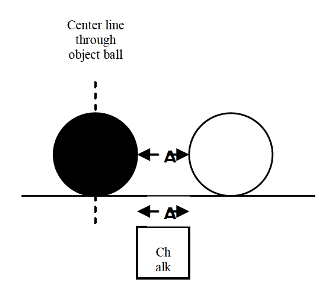
1.32 MISCUES - A miscue is not a foul if the shot is otherwise legal.
1.33 DISTURBED BALLS (CUE BALL FOULS ONLY)
1. It is not a foul to accidentally touch one object ball. If such an accident occurs, the player shall allow the opposing player, in regular league play, or the referee, in a play-off match, to restore the ball to its correct position. If the player does not allow such restoration, and a ball set in motion as a normal part of the shot touches such an unrestored ball, or passes partly into a region originally occupied by a disturbed ball, the shot is a foul. In short, if the accident has any effect on the outcome of the shot, it is a foul. In any case, the opposing player, in regular league play, or the referee, in a play-off match, must restore the positions of the disturbed balls as soon as possible, but not during the shot. It is a foul to play another shot before the opposing player or referee has restored any accidentally moved balls.
2. It is a foul if you disturb more than one object ball.
3. It is a foul if a disturbed ball contacts any other ball.
4. It is a foul to accidentally touch the cue ball.
1.34 JUMP SHOTS AND MASSÉ SHOTS
1. Jump shots are legal shots. However, it is a foul to intentionally cause the cue ball to rise off the bed of the table by "digging under" or "scooping" the cue ball with the cue stick.
2. If you attempt to jump over or massé around an impeding illegal object ball then Rule 1.33, Disturbed Balls, does not apply to the impeding ball for that shot. If the impeding ball moves during the stroke it is a foul regardless of whether it was moved by the cue ball, your equipment or any part of your body.
3. Any attempt to curve the cue ball around an impeding ball is a massé shot, regardless of the degree of elevation of the cue stick or amount of curve.
4. Jump and Masse’ shots are not allowed when the host location does not allow them.
1.35 POSITION OF BALL - The base of a ball determines its position unless otherwise stated in specific game rules. A Chalk Center line through object ball A
1.36 SHOOTING WITH BALL IN HAND BEHIND THE HEAD STRING (Deleted)
1.37 - (Deleted)
1.38 BALL IN HAND PLACEMENT
1. When you have ball in hand, you may use your hand or any part of your cue, including the tip, to position the cue ball. If you use your cue stick to place the cue ball, any action which would be a legal stroke will be considered a shot and must meet the requirements of a legal shot or it is a foul.
2. Once you have picked up the cue ball to take ball in hand, it remains in hand until your next stroke. After it has been picked up, the cue ball may be placed, picked up again and replaced successive times until that stroke is taken.
3. Immediately after a foul, when you are picking up the cue ball the first time to take ball in hand (as opposed to placing the cue ball or picking it up again for successive placements before the next shot), the provisions of Rule 1.33.1 apply to touching or disturbing a single object ball with the cue ball or your hand. You may request that a referee, during a play-off match, pick the cue ball up for you immediately after a foul.
4. When placing the cue ball, it is a foul to touch any object ball with the cue ball or your hand which holds the cue ball. "Hand" is defined as including the wrist up to a point where a wristwatch would normally be worn. If the foul involves only a single object ball your opponent has the option of restoration as described in Rule 1.33. If more than one object ball is involved, there is no restoration option.
1.39 ILLEGAL MARKING - It is a foul if you intentionally mark the table in any way to assist you in executing any shot or future shot. Marking includes the deliberate placement of chalk or any other object at a specific point on a rail or cushion to aid the alignment of a shot or placing any mark on any part of the table. The foul occurs at the moment you attempt to mark the table, regardless of whether you remove the mark, or whether a shot is taken. In addition to any penalty required by specific game rules, an unsportsmanlike conduct warning must be issued; a second violation results in loss of game; a third violation results in loss of match.
1.40 DELIBERATE FOUL - It is a deliberate foul if you:
- intentionally strike the cue ball with anything other than your cue tip;
- pick up the cue ball or contact the cue ball with your hand in order to end your inning;
- intentionally stop or deflect any ball that is in motion;
- catch any ball that is falling into a pocket;
- place your hand into a pocket while any ball is in motion near or toward that pocket;
- cause a ball to move by contacting or moving any part of the table in any way.
- intentionally strike the cue ball with anything other than your cue tip;
In addition to any penalty required by specific game rules, the mandatory penalty for a deliberate foul is an unsportsmanlike conduct warning. A second violation results in loss of game; a third violation results in loss of match. Unless otherwise stated in specific game rules, if you violate (c) your opponent may have the ball either spotted or pocketed. If you violate (d) your opponent may have the ball spotted, placed on the lip of the pocket, or pocketed. The remaining balls are left in position.
1.41 COACHING TIME OUT
1. During regular league play, each player is allowed one coaching time out per game for a maximum of 2 minutes per time out. See Rule 1.14 COACHING for additional guidance.
2. During team play-offs, coaching is limited to 1 minute per game; the presiding referee will give a 30 second and 15 second warning only.
3. During individual’s or women’s and Rising Star WCC play-offs, no coaching is permitted.
4. For any violations see BCA Rule 1.22 Penalties for Fouls.
1.42 NON-SHOOTING PLAYER REQUIREMENT - When it is not your turn, you must not intentionally do anything which distracts your opponent or interferes with their play. Any such act is unsportsmanlike conduct.
1.43 CONCESSION OF GAME - (Deleted)
1.44 CONCESSION OF MATCH - When your opponent is on the hill, if you make a motion to unscrew your playing cue stick during your opponent's inning you lose the match.
1.45 UNSPORTSMANLIKE CONDUCT
1. You must not commit any act which is unsportsmanlike in nature. This includes, but is not limited to, actions which are embarrassing, disruptive, or detrimental to other players, spectators, event officials, or the sport in general.
2. Players are responsible for their actions at all times while they are present at the event venue, whether playing or not.
3. (PLAY-OFFS ONLY) Unsportsmanlike conduct is penalized at the discretion of the referee or other designated event officials. Penalties for unsportsmanlike conduct vary and are based upon the referee’s or event official’s judgment of the severity and nature of the unsportsmanlike act. Referees or event officials have the authority to penalize or disqualify, with or without warning, any player who acts in this manner.
4. (PLAY-OFFS ONLY) Unsportsmanlike conduct warnings and penalties required by rule carry forward only in regard to the specific rule violated. Unsportsmanlike conduct warnings and penalties related to conduct or behavior carry forward and are cumulative during the entire event.
1.46 SPOTTING BALLS
1. Balls to be spotted are placed on the long string with the number facing up. A single ball is placed on the foot spot. If more than one ball is to be spotted, they are placed on the long string in ascending numerical order, beginning on the foot spot and moving toward the foot of the table.
2. If other balls interfere with spotting, the ball(s) will be spotted on the long string below the foot spot but as close as possible to the foot spot without moving the interfering balls. If there is no space available on the long string below the foot spot, the ball(s) will be spotted on the long string beginning at the foot spot and moving toward the head of the table.
3. Whenever possible, spotted balls will be placed frozen to interfering object balls or other spotted balls. If the cue ball is the interfering ball, the spotted ball will be placed as closely as possible to the cue ball without being frozen to it.
1.47 JAWED BALLS (PLAY-OFFS ONLY) - If balls are wedged between the sides of a pocket or between cushions and any of those balls are suspended in the air, the referee will inspect the balls and judge whether, if they were free to fall directly downward, the balls would come to rest on the bed of the table or in the pocket. The referee will then place the balls in the positions as judged and play will continue.
1.48 NON-PLAYER INTERFERENCE - If balls are moved because of the action of a non-player or other influence beyond the control of the players, the opposing player, in regular league play, or a referee, in a play-off match, will restore the balls as nearly as possible to their original positions and play continues. If by player agreement, in regular league play, or by the referee, in a play-off match, it is judged that the balls cannot be restored, the game will be replayed with the player who broke the game breaking again.
1.49 BALLS SETTLING OR MOVING SPONTANEOUSLY - If a ball shifts, settles, turns or otherwise moves "by itself", the ball shall remain in the position it assumed and play continues. A hanging ball that falls into a pocket "by itself" after being motionless for 5 seconds or longer shall be replaced as closely as possible to its position prior to falling, and play shall continue. If an object ball falls into a pocket "by itself" as a player shoots at it, so that the cue ball passes over the spot the ball had been on, unable to hit it, the cue ball and object ball are to be replaced to their positions prior to the stroke, and the player may shoot again. Any other object balls disturbed on the stroke are also to be replaced to their original positions before the shooter replays.
2 8-BALL RULES
2.1 THE GAME - 8-Ball is a call pocket game played with a cue ball and fifteen object balls numbered 1 through 15. Each player or team has a group of seven balls: the solid colored balls numbered 1 through 7, or the striped balls numbered 9 through 15. The 8-ball is the game winning ball. The object of the game is for you to pocket your entire group of balls and then pocket the 8-ball.
2.2 8-BALL RACK - The balls are racked as follows:
- in a triangle with the apex ball on the foot spot;
- the rows behind the apex are parallel to the foot rail;
- the 8-ball is in the middle of the row of three balls;
- the remaining balls are placed at random, except that the ball at each rear corner of the rack must be of a different group than the other rear corner. The left/right orientation of the groups for those two balls does not matter.
- in a triangle with the apex ball on the foot spot;
2.3 8-BALL BREAK REQUIREMENTS
1. You begin the break with ball in hand behind the head string. There is no requirement for the cue ball to contact any particular ball first. You must pocket a ball or cause at least four object balls to contact the cushions or it is an illegal break. If you pocket a ball you continue to shoot; if you do not pocket a ball or you commit a foul, your inning ends.
2. If your break is illegal, your inning ends. Your opponent may:
- accept the table in position if you did not scratch;
- accept the table in position with ball in hand anywhere on the table if you did scratch;
- re-rack the balls and break;
- require you to re-rack the balls and break again.
- accept the table in position if you did not scratch;
3. If you scratch on a legal break and do not pocket the 8-ball, your inning ends and any other pocketed balls remain pocketed. Your opponent has ball in hand anywhere on the table.
4. If you foul on a legal break but do not scratch or pocket the 8-ball, your inning ends and any other pocketed balls remain pocketed. Your opponent may:
- accept the table in position or;
- take ball in hand anywhere on the table.
- accept the table in position or;
5. In all cases on the break, jumped balls, other than the 8-ball, are not returned to the table except in the case of a re-rack.
2.4 8-BALL POCKETED ON THE BREAK
1. If you pocket the 8-ball and do not foul, you may:
- have the 8-ball spotted and accept the table in position or;
- re-rack the balls and break again.
- have the 8-ball spotted and accept the table in position or;
2. If you pocket the 8-ball and scratch your inning ends. Your opponent may:
- have the 8-ball spotted and take ball in hand anywhere on the table;
- re-rack the balls and break;
- require you to re-rack the balls and break again.
- have the 8-ball spotted and take ball in hand anywhere on the table;
3. If you pocket the 8-ball and foul but do not scratch, or if you jump the 8-ball off the table, your inning ends. Your opponent may:
- have the 8-ball spotted and take ball in hand anywhere on the table;
- have the 8-ball spotted and accept the table in position;
- re-rack the balls and break;
- require you to re-rack the balls and break again.
- have the 8-ball spotted and take ball in hand anywhere on the table;
4. If the 8-ball is pocketed on the break and not noticed until after another shot has been taken the game will be replayed with the player who broke the game breaking again.
2.5 TABLE OPEN AFTER THE BREAK - The table is always open after the break and remains open until groups are established. When the table is open, all object balls except the 8-ball are legal object balls and combination shots involving balls of different groups are legal. The 8-ball may be part of such a combination if it is not the first ball contacted by the cue ball. It is a foul if the 8-ball is contacted first.
2.6 ESTABLISHING GROUPS
1. Groups are established when the first object ball is legally pocketed on a shot after the break. The player legally pocketing the first ball is assigned that group, and the opponent is assigned the other group.
2. If all of either group of balls are pocketed on the break or illegally pocketed before the groups are established, either player may legally shoot the 8-ball during their inning. If the 8-ball is legally pocketed on such a shot, the game is won.
3. Once they are established, groups can never change for the remainder of that game. If a player shoots the wrong group and no foul is called before the next shot and the player continues to shoot at that group, or if at any time during the game it is discovered by the player(s) or a referee, during a play-off match, that the players are shooting the wrong groups for any reason and a foul was not called in a timely manner, the game will be replayed with the player who broke the game breaking again.
2.7 CONTINUING PLAY
1. Once groups are established, play continues with each player having their group as legal object balls. Balls in your opponents' group and the 8-ball are illegal object balls. When it is your inning, you continue to shoot as long as you legally pocket a ball on each shot. If you do not legally pocket a ball, your inning ends.
2. Jumped balls and illegally pocketed balls are not returned to the table but do count in favor of the player with that group.
2.8 SAFETY PLAY / NO CALL / NO POCKET - Prior to any shot except the break you may declare a safety. On a safety, your inning ends after the shot regardless of whether or not you pocket any ball, including an obvious ball or a called ball. You must declare the safety to your opponent before the shot, and they must acknowledge your intentions. If you do not declare a safety or it is not acknowledged, and you pocket an obvious ball or a called ball, your inning continues and you must shoot again. Balls pocketed on a safety are illegally pocketed balls. Safety shots must meet the requirements of a legal shot.
2.9 SHOOTING THE 8-BALL
1. The 8-ball becomes your legal object ball on your first shot after the last ball of your group is pocketed. The first player to legally pocket the 8-ball wins the game.
2. With the exception of the provisions of Rule 2.10, if you foul but do not pocket the 8-ball, it is not loss of game. Your opponent is awarded ball in hand.
2.10 LOSS OF GAME - You lose the game if:
- you illegally pocket the 8-ball;
- you jump the 8-ball off the table on any shot other than the break;
- you pocket the 8-ball on the same shot as the last ball of your group;
- you violate any General Rule that requires loss of game as a penalty;
- you pocket the 8-ball on a bank shot that you do not call.
- you illegally pocket the 8-ball;
2.11 STALEMATE - If by player agreement, in regular league play, or by a referee, in a play-off match, it is judged that the table is in a position such that any attempt to pocket or move a ball will result in loss of game, and each player has played three innings without significantly changing the position, the game will be determined to be a stalemate. By player agreement, in regular league play, or by a referee, in a play-off match, a stalemate will be declared and the game will be replayed with the player who broke the game breaking again.
SDPL Bylaws
SDPL Bylaws - EFFECTIVE 07/2026
1.0 GENERAL
1.1 NAME - The name of this League is the San Diego Pool League (SDPL). We are a non-profit 501 c(3) organization.
1.2 PURPOSE - The purpose of the SDPL is to foster regional and national amateur sports competition, and to create an organizational structure for the education and development of amateur competitors.
1.3 PRINCIPAL OFFICE - The principal office of the SDPL shall be located in San Diego, California and the SDPL shall conduct all business through its current address at P.O. Box 3434, San Diego, CA. 92163 and through its website at www.sdpool.org.
1.4 STRUCTURE - The SDPL holds weekly team play on Monday nights in the central San Diego area conducting two (2) seasons each year.
1.5 DISSOLUTION - SDPL's assets are permanently dedicated to public or charitable purposes, and no income or property shall benefit directors, officers, members, or private individuals. If SDPL is dissolved, any remaining assets after debts are paid will go to a nonprofit with 501(c)(3) tax-exempt status, organized solely for public or charitable purposes.
2.0 ORGANIZATION
2.1 MEMBERSHIP - Any individual aged 21 or older who agrees to the Bylaws, Match Policy, and Rules can join the SDPL. Membership is open to all, regardless of race, sex, creed, color, or sexual orientation. Members are organized into teams with a captain and sponsor.
2.2 SPONSORS - Any business or organization may sponsor teams upon meeting the following requirements:
- Arrange for the free use of an acceptable pool table for the 16 games played during each weekly match in a cocktail lounge, tavern or like establishment. An establishment may have no more than 2 teams per pool table.
- Designate one individual as a point of contact between the sponsoring business or organization and the SDPL.
2.3 TEAM - Shall be composed of between four and seven players. It is the responsibility of each member to adhere to the policies and rules of the SDPL. Each team in a division will play every other team in that division at least twice during the season. Team names to be limited to 15 characters/numbers including spaces.
2.4 TEAM CAPTAINS - Are designated by their team members to represent them in the determination of policy that governs the operation/rules of the SDPL, with responsibility for the following:
- Must have a phone, email or contact number.
- Ensure that team members are aware of and adhere to all SDPL Bylaws, Match Policy and Rules.
- Inform team members of upcoming special events such as SDPL tournaments, Pride, etc. to promote player participation.
- Attend all designated Captain’s Meetings or send a representative.
- Act as host when playing at their team’s sponsor bar by performing duties as assigned by the Board.
- Designate a co-captain to act in their absence.
- Both home & visiting captain use the BCAPL App to manage match play and keep score. Verifies score accuracy including wins/losses, table runs, etc. Both submit score via the App at end of match.
- If paper scoresheet used hosting captain must ensure that the score sheet is texted to the Statistician
- Both captains are strongly encouraged to submit weekly dues and any $20 BCAPL new player fee in full via Venmo to the Treasurer as soon as the match has ended.
A team captain can be removed from their position with or without cause, by vote of the team members or by the Board. The team’s sponsor must be notified of the removal.
2.5 TEAM FINES - As required by these Bylaws, Team Fines will be assessed by the following:
- Failure to submit match scores or weekly match fees within 24 hours after the start of your match will result in a $5.00 fine per occurrence.
- Failure to have team representation at a scheduled Captains meeting is a $10.00 fine.
2.6 TEAM PLAYER ADDITIONS – New players may be registered and play on the same night provided $20 BCAPL dues are paid to the Treasurer, except for the last 4 weeks of the season during which time no new players may be registered or play on any team. Any player added to an existing roster who has qualified as playing 50% or more of the total season games in a division and completed with an average of 50% or higher wins within the last 3 previous seasons may not be added or move into a lower division without the permission of the Board. The Board is authorized, at its discretion, to allow players to move to a lower division.
2.7 TEAM DROPOUTS - Any team accumulating 16 or more forfeits during any one season may be dropped from the league. If the team to be dropped completed all their matches during the 1st half of the season (this means, without any forfeits occurring in the first half) all matches, wins and losses from opposing teams and individuals will stand and only those scores from the 2nd half of the season will be eliminated. No individual who was part of a dropped team can qualify for playoffs or awards. All money paid into the league by the forfeiting team will be forfeited.
2.8 DIVISIONS - Divisions will be set at a formal Board meeting as soon as possible before the new season, using registration forms and last season’s standings. The statistician will provide final stats and a proposed lineup of divisions and teams. Teams that finish first move up; teams that finish last move down, if there are minimal player changes. With no team additions, removals, division changes, or Board concerns, the new lineup may be approved. Steps to completion are:
- Finalize the number of new and existing teams.
- Redraw line-up with new team additions, division change requests and any Board concerns assigning teams of comparable overall skill by Division with A division the most advanced.
- Finalize the number of divisions with approximately the same number of teams for each division limiting the number of byes and recognizing fiscal effects.
- Review final new season line-up for Board approval.
3.0 FEES
3.1 STRUCTURE - It is each member’s responsibility to pay SDPL assessed fees at such time, place and in an amount established. Fees will be assessed as follows:
- Team registration fee
- Weekly player’s fee
3.2 SPONSOR REGISTRATION FEE - deleted Spring 2025.
3.3 TEAM REGISTRATION FEE - Shall be $25.00 per team per season payable on the first night of season play. This fee registers the entire team and these funds will go into the SDPL operating fund.
3.4 WEEKLY PLAYERS FEE – Shall be $40.00 per team ($2.50 per game) per week of regular play, payable at the match each week. The full amount is payable each week without exception. Each player playing that week shall pay their portion of the player fees as determined by the team captains. Regardless of the number of players, $40.00 is due without exception. These funds will go into the SDPL operating fund.
3.5 – TOURNAMENT FEE’S – The Board shall determine and timely communicate tournament entry fees needed to support ongoing SDPL expenses.
3.6 DISBURSEMENT OF LEAGUE MONIES – All moneys collected each season shall be used for the purpose of providing its members with trophies or other awards (as outlined in the bylaws under Tournaments and Awards), an award banquet, funding West Coast Challenge participation and Board approved SDPL operating expenses.
4.0 BOARD OF OFFICERS
4.1 GENERAL - The members of the SDPL teams shall elect a Board of Officers, herein referred to as the “Board”, to manage and control SDPL affairs and finances. No member of the Board shall be personally liable for any debts, liabilities or obligations of the SDPL. Board and league members can be held accountable, however, for any money or property for which they had assumed responsibility. Officers and team captains shall serve with compensation as approved by the team captains.
4.2 NUMBER OF BOARD MEMBERS - The Board of Officers shall consist of six elected members.
4.3 NOMINATIONS - During the first four weeks of a team’s scheduled play, members interested in running for a Board position shall indicate so on their Monday night score sheet. All members have the option to present information to the statistician regarding their qualifications and/or reasons for seeking a Board position. The information will then be communicated to membership via current channels with a maximum of seventy-five words. All nominations of league members will be confirmed by the Board prior to the ballot phase.
4.4 TERMS OF OFFICE - An officer’s term is for 2 seasons. A newly elected officer will assume office immediately following the end of the current season. To support the transition, immediately following election a new officer shall partner with the retiring officer in his/her duties and support the Board as needed in completing the current season.
4.5 NEWLY CREATED BOARD POSITIONS - All newly created positions to the Board of Officers shall be eligible for candidacy and election at the next regularly scheduled Mid-Season’s Captains’ meeting. If the newly elected Board of Officers, at their first scheduled Board meeting, should determine a need for the newly created position to be filled, then it may temporarily appoint a person to the position until the league members can vote on the candidates.
4.6 ELECTIONS - All officers of the Board of Officers shall be elected by office. The election of such offices shall be by the staggering of elections. To wit: the Spring Season shall have the election of the Vice President, Statistician and Secretary. The Fall Season shall have the election of the President, Treasurer and Community Relations Officer. At the end of the nomination process, the Secretary shall notify all nominees of their nomination to gain their consent. If any person has been nominated for more than one office, the Secretary shall notify such person of all nominations to gain their consent and determine which office they wish to pursue. No person shall be placed on the ballot for more than one office per election cycle.
4.7 BALLOTS - If more than one person is nominated for the same Board position, individual ballots will be distributed to each team member prior to the mid-season captains meeting. All team members present who have played at least 1 game prior to ballot issuance can cast a vote for one person in each office. Completed ballots will be put in the provided envelope and sealed. Members having voted will print and sign the front of the envelope. Ballot envelopes will be opened and tabulated at the Mid-season Captains meeting supervised by a non-board member representative from each division chosen at random at the meeting. Candidates with a majority of votes are elected.
4.8 TIE VOTES - Ties shall be broken by a vote of the team captains.
4.9 BOARD POSITIONS - Prior to the start of each season, each current Board Member leaving will provide detail accounting of the position to the newly elected Board member.
4.10 OFFICERS - The officers of the SDPL shall be a President, Vice President, Secretary, Treasurer, Statistician and Community Relations Officer. No person may hold more than one office at a time. Officers shall have the following respective duties.
4.11 GENERAL RESPONSIBILITIES OF OFFICERS - Shall include but not be limited to the following:
- Meet at least once per month at a time and place set by the Board and made known to the SDPL membership.
- Ensure SDPL bylaws, match policy and rules are free of spelling and grammatical errors, presented clearly, and make changes that do not alter the underlying bylaw, policy or rule. Such changes are considered incidental and do not require captains approval.
- Enforce SDPL bylaws, match policy and rules by taking appropriate action against teams or individuals who violate Bylaws, Match Policy and Rules or anyone whose conduct is deemed detrimental to the SDPL.
- The Board may review, add, remove, or reassign position duties with a 2/3 majority Board vote to maintain efficient administration of SDPL Bylaws, rules and policies.
- Plan and coordinate SDPL’s special events, regular season, playoffs, tournaments and participation in the West Coast Challenge.
- Attend at least 75% of the total Board meetings during the season or obtain the Board’s consent for any absences.
- Have an e-mail address and phone number and be a current member of the league.
- Appoint Board Members at Large by majority vote
- Publish a player’s handbook each year containing Bylaws, Match Policy and Rules.
- Publish League Histories or other information (optional).
- Participate as referees at West Coast Challenges, when needed.
- Perform other duties as assigned by the Board.
4.11.1 PRESIDENT:
- Shall be the Chief Executive Officer of the SDPL, responsible for conducting meetings, coordination of all functions of the Board and implementation of SDPL policy.
- Accept responsibility for the duties assigned to any other Board member, which that member is unable or unwilling to perform.
- Act as ex-officio member of all committees.
- Responsible for communication with and management of the SDPL website and Webmaster.
4.11.2 VICE PRESIDENT:
- In the absence or disability of the President, perform all duties of the President.
- Chair a minimum of two Rules Committees each season in advance of the captains meeting or as often as may be required by the Board, notifying league members 2 weeks prior to the meeting via current communication channels.
- Chair all special events committees.
- Resolve any disputes that appear on the score sheets within two weeks or submit them to the Board for resolution.
- Examine all potential sponsor bars (prior to the start of the season) and report to the Board any deficiencies which might disqualify them from league play, such as rips, being un-level or not having at least 2 sides free of obstruction for use of a full-size cue stick.
- Plan and coordinate all special event tournaments, playoffs and West Coast Challenge matches.
4.11.3 SECRETARY:
- Record and keep the minutes of all Board, Captains and Rules Committee Meetings.
- Maintain correspondence with all other cities regarding the West Coast Challenge.
- Mail letters of reprimand.
- Maintain copies of all SDPL forms and paperwork.
- Notify all captains, via email or phone, at least one day in advance of all Rules Committee and Captains meetings.
- Notify captains at least one week in advance of all special events.
- Proofread the handbook prior to printing and publish the Table Talk.
- Maintain an on-going record of all league member’s phone numbers and mailing addresses.
- Collect all league paperwork including, standings, Table Talks, minutes, financial reports and score sheets from the appropriate officers and store safely until turned over to the historical society.
- Maintain copies and update the website each season with Perpetual League Histories and In Memoriams.
4.11.4 TREASURER:
- Responsible for SDPL bookkeeping and banking functions.
- Provide a budget for each season’s activities.
- Deposit all moneys collected within 3 days of receipt and furnish documentation of same upon demand.
- Demand and keep proper documentation of all expenditures according to accepted accounting procedures.
- Prepare financial statement at the beginning of the season and at the Mid-Season Captain’s meeting.
- Shall be required by a majority vote of the Board for any expenditure over $50.00 and shall be cosignatory with at least 1 other officer on all SDPL accounts.
- Management of the SDPL P.O. Box, including renewals, keys, etc.
- Provide all reports required to maintain the SDPL non-profit status, including but not limited to the CA secretary of State (SoS), Franchise Tax Board (FTB) and the Internal Revenue Service (IRS) as well as maintain the records to support the filings.
- Will account for money received from teams for each night of play and ensure that all team payments are up to date.
4.11.5 STATISTICIAN:
- Responsible for all entries of league standings including, but not limited to team standings, team rosters and Top 20 list.
- Update Bylaws, Match Policy, Rules and Histories. Certifying and retaining the original copies of these Bylaws as shall be amended.
- Shall maintain “user friendly” instructions for the performance of the Statistician’s job duties pertaining to the league standing sheets and shall do the typesetting for the handbook.
- Shall also review the score sheets for disputes and forfeits ensuring that the original score sheet is filed properly.
- Shall advise the Treasurer of any financial issues noted on scoresheet.
- Shall advise Vice President of any disputes noted on the scoresheet.
4.11.6 COMMUNITY RELATIONS:
- Shall be responsible for maintaining an ongoing contact with local publications, providing them with league statistics and upcoming event information.
- Shall assist Statistician in procurement of ads for the handbook and other league publications as needed.
- Shall be responsible for coordination of all Gay and Lesbian Pride events.
- Shall be responsible for distribution of all league posters and flyers.
- Shall chair the Charity committee and share the responsibility of procuring items for the Heinen Charity Tournament.
- Shall perform other duties as assigned by the Board.
- Shall be responsible for maintaining an ongoing contact list of current league sponsors. List should include owner, manager or league liaison, sponsor address, sponsor phone number, and sponsor contact email.
- Shall be responsible for overseeing all social media.
- Shall be responsible for mailing Sponsor invitations to Awards Banquet and correspondence pertaining to the Charity Tournament.
4.11.7 BOARD MEMBER AT LARGE:
- Shall be an appointed position whose responsibilities will vary from season to season.
- General responsibilities will include but not be limited to assistance in special events, playoffs and the West Coast Challenge.
- Term will be one season and may be reappointed each new season by the Board.
- This is a non-voting position.
4.11.8 WEB MASTER: Appointed and removed by majority vote of the Board. Responsibilities include, but not limited to:
- Maintaining a user-friendly Web Site.
- Making changes and updates when instructed by President or appointed Board members. Maintain a back-up of SDPL website information.
- Compensation shall be set by Board.
- This is a non-voting position.
4.12 RIGHTS OF OFFICERS - All rights granted to the Board by these Bylaws may be revoked at any time by 2/3 vote of the team captains. The Board has the right to interpret Bylaws and grant exception when exception is just and for the benefit of the league.
4.13 OFFICE VACANCIES - Should any vacancy occur during an officer’s term, the SDPL Board shall appoint someone to fill the vacant position. If a current elected member of the Board fills the vacancy, they will finish the term of their new office. If a new member is appointed to the Board to fill the position, they must be re-elected at the next Mid-Season Captains meeting or be replaced immediately by the newly elected member.
4.14 PRESIDENTIAL RESIGNATION - In the case of a President resigning and a Vice President who is unable to take over the responsibilities, the Board, by majority vote, may appoint a replacement. An election will be held at the next fall Mid-Season Captains meeting.
4.15 REMOVAL OF OFFICERS - An officer may be removed from office at any time, with or without cause, by a 2/3 vote of the total number of team captains, failure to attend at least 75% of total Board meetings, failure to carry out the responsibilities of their office or by a simple majority of the Board.
5.0 MEETINGS
5.1 GENERAL - All meetings of the SDPL are open to members. There will be an agenda for each meeting. In the interest of order and assuring the accomplishment of items set forth on the agenda, the chair has the right to limit discussion on all matters. Notwithstanding, the chair will make every attempt to hear any matter that an SDPL member wishes to address.
5.2 MEETING RULES - Meetings shall be governed by Robert’s Rules of Order as long as they are not in conflict with these Bylaws.
5.3 CAPTAIN’S MEETINGS - Without exception, attendance is mandatory for each team captain or their designated representative. Only team captains or their designated representative are eligible to vote. All business affecting SDPL Bylaws, Match Policy, Rules and elections are voted upon at these meetings. Meetings are open to all members of the SDPL and notice of such meetings shall be made available at the start of each season.
5.4 RULES COMMITTEE MEETINGS (RCM) – Shall be chaired by the Vice President with Secretary in attendance. President shall intercede if either cannot attend. Open to all current members of the SDPL, with each member attending who is eligible to vote. All business affecting changes, additions or deletions to SDPL Bylaws, Match Policy & Procedures or Rules must first come before a scheduled Rules Committee meeting. All motions passed by a simple majority at committee will then be brought before the Board for voting. No motion affecting SDPL Bylaws, Match Policy & Procedures or Rules shall be brought before the captains without first being brought before and passed by the Rules Committee and then the Board. Notice of all meetings must be made available to the membership at least two weeks prior to the date of the meeting. Members who cannot attend the meetings are welcome to present any new ideas in writing to the Vice President or Secretary prior to any RCM meeting.
5.5 BOARD MEETINGS - All Board meetings are open to the membership with only elected or appointed elective Board members eligible to vote. All motions coming out of any Rules Committee must be voted upon and passed by a majority vote of the Board. All business affecting SDPL policy, expenditures of money, playoff scheme, divisional format and WCC plans are made at these meetings. Non-scheduled Board meetings (when necessary) may be called following the notification of all Board members.
5.5.1 BOARD EMAIL-VOTES – In such cases where a SDPL business matter of urgent, necessary or required procedure is called for, the President may call for an Email-vote to resolve such matters. President shall notify the Secretary of motion. Secretary will issue email and follow-up on Board replies. Majority vote of the complete Board required to pass. Board will be notified of Pass/Fail status and a final email will be issued with complete results. The secretary shall archive all email votes for retention.
5.6 QUORUM - Simple majority of team captains will constitute a quorum at any Captain’s meeting. No quorum is necessary at a Rules Committee meeting. At least four (4) voting Board members must be present at a Board meeting. No business shall be considered at any meeting at which a quorum is not present.
6.0 CHANGES TO BYLAWS, MATCH POLICY, RULES & HISTORIES
6.1 PROCEDURE - All additions, deletions or changes to current SDPL By Laws, Match Policy and Play and Rules, (that directly alter the intent or purpose of existing language), must first be passed by a majority vote of league members attending the Rules Committee Meeting , followed by a majority vote of the Board, followed by a 2/3 vote at the Captains Meeting, All changes to By Laws, Match Policy and Rules take effect the following season and will be updated on the web site and communicated via current channels. The Board by majority vote may have change(s) become effective immediately or at a date set by the Board sooner than the following season so long as the change(s) do not directly affect activity in the current season. Any motion passed at a Rules Committee meeting but voted down by the Board may still be presented for a vote at the Mid-Season Captains meeting so long as the Board is notified in writing prior to that meeting.
6.2 HISTORY CHANGES - All additions, changes or deletions to league histories must be approved by unanimous vote of the Board.
6.3 HANDBOOKS – Any changes and / or updates to rules used by the SDPL will take affect the following season. Any such modifications to the rules will be posted on the website and will be included in the next production of the rules.
7.0 PLAYOFF TOURNAMENTS
7.1 GENERAL - After each regular season, SDPL holds playoff tournaments to select top teams and players in various categories. The spring season playoffs and tournaments may also decide our representatives for the West Coast Challenge (WCC).
7.2 ELIGIBILITY - Players wishing to participate in the team playoffs must have played at least 25% of the games possible.
7.3 FORMAT - The top four teams in each division will qualify for team playoffs. Any tie breakers will be done as per Bylaw rule 7.3.1 Ties. The lowest division will play the next lowest division on the first regular night of play after the end of the season. All Play Off matches will be a race to 9.
Team Placement:
Teams will be placed in the bracket according to their individual finishes. The #4 team from the lowest division will play the #1 team from the next higher division, #3 will play #2, #2 will play #3, and #1 will play #4.
The higher division team will be the home team. Once placed no modifications to the bracket will be permitted due to upsets. The winning team of the first playoff will then play the next higher division, so on and so on until the top 3 teams have been determined.
7.3.1 TIES – At the end of the season Team and Individual ties for seeding will be decided by:
Team
- Total games won against each other.
- Total games won during the first half of the season.
- Coin toss between Captains or Co-captains.
Individuals
- Total games won against each other.
- Total games won over the entire season.
- Coin toss between players.
8.0 TOURNAMENTS - The West Coast Challenge (WCC) occurs annually, with qualifying events typically held during the preceding Spring season. The Board shall determine and communicate in advance all tournament entry fees. Seeding & bracket placement for Open Individuals, Women’s, and Rising Star based on 1) percent of wins then 2) number of wins. See 7.3.1 TIES for resolving individual player ties.
8.1 CLEMENS CAPTAINS CLASSIC - Open to each team captain, or in their absence a co-captain, who is present for the Captains meeting. This tournament, which traditionally follows the Mid-season Captains meeting, is a single game, double elimination tournament with placement in the bracket done by random draw following the placement of any necessary byes.
8.2 OPEN INDIVIDUAL’S TOURNAMENT - Open to all individuals who have played at least 50% of all possible games as of tournament date. This tournament is a seeded, best of 5, double elimination competition and will decide the league’s 1st through 6th WCC Open Individuals and alternates. Registration begins 30 minutes prior to start time.
8.3 WOMEN’S TOURNAMENT – Open to all players who play as women during the regular season and have played at least 50% of all possible games as of tournament date. This tournament is a seeded, best of 5, double elimination competition and will decide the league’s 1st through 4th WCC Women’s competition individuals and alternates. Registration begins 30 minutes prior to start time.
8.4 TOPS & BOTTOMS - Open to all league members who play at least 50% of all games possible as of tournament date. This tournament is a best of 3 double elimination pairs event where the top seeded player present from the highest division is paired with the lowest seeded player from the lowest division present and so on. Placement of teams in the bracket is done by random draw following the placement of any byes if necessary. Team players alternate shots and unlimited coaching is permitted. Being a team event, an even number of players are required. If an odd number of players register and no one volunteers to withdraw, the player last to register will be disallowed. Registration begins 30 minutes prior to play.
8.5 RISING STAR - It is a best of 5, double elimination tournament and will decide the league’s 7th and 8th place WCC Open Individual.
Qualifications:
All Players must have played 50% of all possible games as of tournament date.
Open to all qualified lower division players.
Registration begins 30 minutes prior to start time.
During fall season tournament only (non-WCC qualifier) each player is allowed 1 one-minute coaching per game from a non-participating SDPL member (excluding tournament directors). In keeping with friendly sportsmanlike play, participants are to self-monitor coaching time and notify each other when time is ending so coach can wrap up his/her consultation. It is not a foul to slightly exceed the allotted time.
8.6 THE HEINEN CHARITY TOURNAMENT - Held once a year. Entry fee shall be determined by the Charity Committee hosting the event. The proceeds from this tournament are donated to a Board designated charity.
8.7 Las Vegas / Palm Springs Invitational – Deleted Fall 2025
9.0 AWARDS
9.1 GENERAL - Divisional trophies will be awarded to the top 3 teams in each division and the top 3 individuals in each division. The top 3 individuals from each division will be determined from the end of season standings of the Top 20 individuals who have played at least 50% of all games possible. League trophies will be awarded to the top 3 teams in the league. In the event of a tie, see rule 7.3.1 for determining tie breaker. The Board is authorized to reduce the number of team awards per division if the number of teams in the division is 6 or fewer.
9.1.1 Limits to Awards - No Awards will be given to players who have not played at least 25% of all games possible. The team may opt to pay for an additional award for such players.
9.2 CERTIFICATES
9.2.1 TR’s / 4&0’s – Table Runs or TRs are defined as a player legally pocketing all possible object balls in their first inning. 4&0s are defined as a player winning 4 games in a team match. Forfeits do not count toward 4&0 certificates. Those individuals in each division having the most table runs and 4&0’s, including ties, will receive a certificate.
9.2.2 Steve Holt Endurance Award – Players who play all possible match games in a season will receive a certificate for their participation. All forfeits will count as games played.
9.3 MULTIPLE AWARDS - In the event that a player qualifies for multiple awards in a single season, the Board will issue the awards based on the player’s option listed below.
Player Options:
- Receive a single award with a single plate listing all combined accomplishments for that season; or
- Receive a Perpetual Individual 12” x 15” Plaque containing league logo, season joined the league and space for 14 1” x 5’ metal plates. If this option is chosen, members will receive a single plate each season, until their plaque is full, listing their accomplishments for that season to affix to their plaque. Members will be eligible to receive a new plaque once their plaque is full. Any upgrades or extra costs are the responsibility of the player.
9.4 TOURNAMENT AWARDS - Trophies will be awarded to the top three teams in the play-offs, the first place individual for the Charity Tournament, the top 3 individuals in the Clemens Captains Classic, the top eight finishers in the Individual's, the top four finishers in the Women's, the top 3 teams in the Tops & Bottoms Tournament and top 3 individuals in the Rising Star Tournament. The Board, at its discretion and based on the number of the tournament players, may adjust the number of tournament awards.
9.5 PERPETUAL TROPHIES - The team perpetual trophy will be displayed at the Sponsoring Bar where the team played. Individual trophies shall be displayed at the Sponsoring Bar where the individual currently plays. Tops & Bottoms trophy will be seasonally split between Sponsoring Bars where the individuals currently play. The Board may decide to display these trophies at another location for safekeeping.
9.6 CELEBRATED ACHIEVEMENTS
9.6.1 SAN DIEGO HALL OF FAME AWARD - The SDPL Hall of Fame Awards are an acknowledgment for members of our league who have had success in Team playoffs, Open Individuals, Women's competition and all other qualified league tournaments as well as for loyal members for their many years of participation. A perpetual display case shall hold the name plates of both Gold plate and Silver plate recipients and will be displayed every 5 seasons beginning at our 75th season Awards banquet. Every 5 seasons the President shall appoint a SDHF committee who shall compile statistics and provide eligible names for each category. Any qualified player that may be overlooked shall be inducted at the next designated Awards Banquet.
Gold Plate: For achievement in SDPL team playoff and SDPL qualifying tournaments. Members accumulating a total of 25 points shall be inducted into the SDPL Hall of Fame. Points awarded as follows: 2 points for every first place finish in any SDPL qualifying tournament except for team. 1 point for every 1st place team finish and every other trophy position in SDPL qualifying competitions. Inductees shall receive a gold name plate in the perpetual display case.
Silver Plate - For loyal members of our League who have participated in 40 or more seasons.
Recipients shall get a silver name plate in the perpetual display case.
9.6.2 WEST COAST CHALLENGE HALL OF FAME AWARD - Any member inducted to the WCC Hall of Fame must have received a total of 20 points to qualify:
- 1 Point will be awarded for any Team Championship.
- 2 points for every 1st Place finish in Individuals, Women’s competition or Hi/Lo.
- 1 point will be awarded for any 2 - 8 Individual's finish or 2 - 4 Women’s finish.
- 1 point for every WCC appearance as a Player, Referee or Board member.
- 2 additional points will be given to any Board member/Referee who acts a Tournament Director during a WCC.
All qualifying members are voted upon with 2/3 vote of entire Board in order to be inducted with preference given to those individuals whose accomplishments surpass those of other qualified individuals. A bio write-up of WCC SD inductees will be provided by the Board for review and approval by the player before it is printed in the WCC SD program.
9.6.2.1 WEST COAST CHALLENGE HALL OF FAME TROPHY - per WCC standing policy, all WCC Hall of Fame trophies must be issued with the oval 8” PDU Pool award with the specific wording of: "West Coast Challenge (#)/San Diego (Date) / Hall of Fame/ Player’s Name"
9.6.3 DISTINGUISHED SERVICE AWARD - Awarded to those league members whose service, leadership and contributions as a Board member have proven to be invaluable to the league in a manner above and beyond the call of duty. At a President's request, a 3 person committee shall be appointed by the Board. The committee shall include previous or current Board members providing they are not a nominee. The committee shall provide a list of 3 nominees and their qualifications to the Board. Qualifications for the Distinguished Service Award shall include a minimum of 10 seasons as a voting Board member plus additional participation such as Member at Large, Committee Chairs and other notable contributions. The Board shall vote by secret ballot for one nominee. If a nominee receives 2/3 (4) votes, he/she will receive the Distinguished Service Award. Only one DSA may be awarded per season.
9.7 SPECIAL SERVICE AWARD - Selected by majority vote of the Board and presented to those individuals, sponsors or businesses that have provided a cumulative service to the league.
9.8 PRESIDENTIAL AWARDS - Selected by the President optionally as a thank you to individuals, sponsors or businesses who have provided contributions of time and effort for the betterment of the league.
9.9 WALKER AWARD - Certificate awarded to those individuals who accomplish both a 4&0 and 4 Table runs on a single night of play. (See rule 9.2.1 for definitions of a Table Run and 4&0)
10.0 WEST COAST CHALLENGE (WCC)
10.1 GENERAL - The SDPL will be a participant in the WCC, funding city registration fees, lodging, travel and expenses for the Board, referees, top Team (6 players), top 8 Open Individuals, top 4 from the Women’s Competition and the winning Tops & Bottoms team. When required, the SDPL will fund expenses for San Diego to host the West Coast Challenge. All players, referees and Board members will be required to attend both opening and closing ceremonies and be present during all scheduled match times. Early releases must be approved by the SDPL Vice President or the SDPL WCC Coordinator. Participant representatives shall be available to referee matches after elimination from tournament play. The penalty for not fulfilling your obligations as a San Diego representative is suspension from the West Coast Challenge and special event tournaments for 1 season the player is actively playing.
10.1.1 SHARE OF COST - The Board may impose a share of cost for all WCC participants to help cover expenses and lodging in an amount to be determined by the Board. Members must be made aware of any such fees prior to the start of WCC qualifying tournaments.
Participants will be responsible for their own transportation expenses for Palm Springs, LA, LB and SD events.
10.2 SAN FRANCISCO
10.2.1 For the purposes of paragraph 10.2, “participant” is defined as any member of SDPL attending the WCC in any official capacity, whether playing or not. Updated July 2026 Page 18
10.2.2 When the West Coast Challenge is hosted in San Francisco, each San Diego participant shall have the options of either 1. Arranging their own travel, or 2. Accepting the flight tickets provided by the SDPL Board.
10.2.3 These options shall be communicated to the Board by each participant prior to the purchase of airline tickets by the Board. In the absence of such communication, the Board will assume the second option for the participant in question.
10.2.4 For those choosing the first option: The Board shall reimburse that participant their actual cost, but not to exceed the cost of a ticket as provided to those who chose the second option. All Participants seeking reimbursement must provide receipts to the board.
10.2.5 For those choosing the second option: In the event of a cancellation by the participant for any reason, the participant shall be responsible for returning to the SDPL the cost of the ticket, and any fees imposed upon and paid for by the Board consequent to the cancellation.
10.3 RULES - Billiard Congress of America (BCA) rules are used in West Coast Challenge play. Double elimination team & individual format.
11.0 UNSPORTSMANLIKE CONDUCT
11.1 PROCEDURES - The Board will, upon its finding of such conduct, discipline any player by the following progressive actions:
For the first infraction, a letter of reprimand will be written to the individual in question and their sponsoring bar.
For the second infraction, a letter of reprimand will be written to the individual in question as well as their sponsoring bar and they will forfeit all of the player’s games during the match in which the incident took place.
For the third infraction, they will be expelled from the SDPL.
12.0 APPROVED TOURNAMENT BRACKETS
12.1A SEEDED 16 TEAM SINGLE ELIMINATION BRACKET
12.1B 16 PLAYER DOUBLE ELIMINATION TOURNAMENT BRACKET
12.1C 32 PLAYER DOUBLE ELIMINATION TOURNAMENT BRACKET
12.1D 64 PLAYER DOUBLE ELIMINATION TOURNAMENT BRACKET
Glossary of Terms
GLOSSARY OF BILLIARD TERMS
From the 'BCA Official Rules and Records Book'.
ANGLED. (Snooker, pocket games) When the corner of a pocket prevents a player shooting the cue ball directly at an object ball. (See corner-hooked)
ANGLE SHOT. (Pocket games) A shot that requires the cue ball to drive the object ball other than straight ahead. (See cut shot)
APEX OF TRIANGLE. (Pocket games) The position in the grouping of object balls that is on the foot spot; the front ball position of the pyramid or rack.
AROUND THE TABLE. (Carom games) Describes shots in which the cue ball contacts three or more cushions, usually including the two short cushions, in an effort to score.
BALANCE POINT. (General) The point on a cue at which it would remain level if held by a single support, usually about 18" from the butt end of the cue.
BALL IN HAND. (Pocket games) See cue ball in hand.
BALL ON. (Snooker) A colored (non-red) ball a player intends to legally pocket; same as on ball.
BANK SHOT. (Pocket games) A shot in which the object ball is driven to one or more cushions before it is pocketed; incidental contact as a ball moves along and adjacent to a cushion does not qualify as a cushion or bank. It is not an obvious shot and must be called in games requiring called shots. (See kick shot)
BAULK. (Snooker) The intervening space between the bottom cushion and the Baulk-line.
BAULK-LINE. (Snooker) A straight line drawn 29" from the face of the bottom cushion and parallel to it.
BED OF TABLE. (General) The flat, cloth-covered surface of the table within the cushions; the playing area exclusive of the cushions.
BILLIARD. (Carom games) A count or score; a successful shot.
BLIND DRAW. (General) A method used to determine pairings or bracketing of players in tournaments that assures totally random placement or pairing of contestants.
BOTTLE. (Pocket games) A specially shaped leather or plastic container used in various games. (Also called the shake bottle)
BOTTOM CUSHION. (Snooker) The cushion located at the head of a snooker table--closest to the D.
BREAK. (Pocket games) See open break and opening break shot.
BREAK. (Snooker) Total scored in one inning.
BREAKING VIOLATION. (Pocket games) A violation of special rules which apply only to the opening break shot of certain games. Unless specified in individual game rules, a breaking violation is not a foul.
BRIDGE. (General) The hand configuration that holds and guides the shaft-end of the cue during play. (See mechanical bridge)
BURST. (Forty-One Pocket Billiards) Scoring a total of more than 41 points.
BUTT OF CUE. (General) The larger end of a cue, opposite the tip. On a two-piece cue, the butt extends up to the joint.
CALL SHOT. (Pocket games) Requirement that a player designate, in advance of each shot, the ball to be made and the pocket into which it will be made. In calling the shot, it is NEVER necessary to indicate details such as the number of cushions, banks, kisses, caroms, etc. The rules of "Bank Pool" are an exception.
CALLED BALL. (Pocket games) The ball the player has designated to be pocketed on a shot.
CALLED POCKET. (Pocket games) The pocket which a player has designated a ball to be shot.
CAROM. (General) To bounce off or glance off an object ball or cushion; a shot in which the cue ball bounces off one ball into another is termed a carom.
CAROM, SCORING. (General) Contact by the cue ball with object balls, the bottle or cushions in such a way that a legal score is made, according to specific game rules.
CENTER SPOT. (General) The exact center point of a table's playing surface.
CHALK. (General) A dry, slightly abrasive substance that is applied to the cue tip to help assure a non-slip contact between the cue tip and the cue ball.
CHUCK NURSE. (Straight Rail Billiards) A scoring technique used when one object ball rests against the cushion and the second object ball is to one side of the first ball and away from the cushion. Cue ball strikes the object ball at the cushion so that the cue ball just comes back to touch (carom) the second object ball without moving it out of position for a similar subsequent shot.
CLEAN BANK. (Bank Pocket Billiards) A shot in which the object ball being played does not touch any other object balls (i.e., no kisses, no combinations).
CLEAR BALL. (Carom games) The all-white ball, devoid of any markings, used in carom games. (See spot ball)
COMBINATION. (Pocket games) Shot in which the cue ball first strikes a ball other than the one to be pocketed, with the ball initially contacted in turn striking one or more other balls in an effort to score.
COMBINATION ON. (Pocket games) Two or more balls positioned in such a way that a ball can be driven into a called pocket with a combination shot; often called a "dead combo" or an "on combo."
COMBINATION ON. (Snooker) See plant.
CONTACT POINT. (General) The precise point of contact between the cue ball and the object ball when the cue ball strikes the object ball.
CORNER-HOOKED. (Pocket games, Snooker) When the corner of a pocket prevents shooting the cue ball in a straight path directly to an object ball, the cue ball is corner-hooked; same as angled.
COUNT. (General) A score; a successful shot.
COUNT, THE. (General) The running score at any point during a player's inning in games where numerous points are scored successively.
CROSS CORNER. (Pocket games) Term used to describe a bank shot that will rebound from a cushion and into a corner pocket.
CROSS SIDE. (Pocket games) Term used to describe a bank shot that will rebound from a cushion and into a side pocket.
CROSS TABLE SHOT. (Carom games) Shot in which scoring is accomplished by driving the cue ball across the table between the long cushion.
CROTCH. (Carom games) The corner area of a carom table in straight-rail billiards in which a player may score no more than three successive counts with the balls before driving at least one object ball out of the area. The four crotches are defined as those spaces within crotch lines drawn between first diamond on the end rail to the second diamond on the side rail.
CRUTCH. (General) Slang term for the mechanical bridge.
CUE. (General) Tapered device, usually wooden, used to strike the cue ball to execute carom or pocket billiard shots. (Also called cue stick)
CUE BALL. (General) The white, unnumbered ball that is always struck by the cue during play.
CUE BALL IN HAND. (Pocket games) Cue ball may be put into play anywhere on the playing surface.
CUE BALL IN HAND BEHIND THE HEAD STRING. (Pocket games) Cue ball may be put into play anywhere between the head string and the cushion on the head end of the table not in contact with an object ball.
CUE BALL IN HAND WITHIN THE D. (Snooker) See cue ball in hand within the half-circle.
CUE BALL IN HAND WITHIN THE HALF-CIRCLE. (Snooker) The cue ball is in hand within the half-circle when it has entered a pocket or has been forced off the table. The base of the cue ball may be placed anywhere within or on the half-circle. It remains in hand until the player strikes the cue ball with the tip of the cue or a foul is committed while the ball is on the table.
CUE TIP. (General) A piece of specially processed leather or other fibrous or pliable material attached to the shaft end of the cue that contacts the cue ball when a shot is executed.
CUSHION. (General) The cloth-covered rubber which borders the inside of the rails on carom and pocket billiard tables; together the cushions form the outer perimeter of the basic playing surface.
CUT SHOT. (Pocket games) A shot in which the cue ball contacts the object ball to one side or the other of full center, thus driving it in a direction other than that of the initial cue ball path.
D. (Snooker) An area, semi-circular in shape, with the straight side formed by the line drawn between the spot for the yellow and the spot for the green measured 29 inches out from the face of the bottom cushion (sometimes referred to as the baulk line) and the semi-circle is determined by the size of the table being used.
DEAD BALL. (Pocket games) A cue ball stroked in such a manner that virtually all of the speed and/or spin of the cue ball is transferred to the object ball, the cue ball retaining very little or none after contact.
DEAD BALL SHOT. (Pocket games) A shot in which a dead ball stroke is employed; often called a kill shot, because of the relative lack of cue ball motion after contact with the object ball.
DEAD COMBINATION. (Pocket games) See combination on.
DIAMONDS. (General) Inlays or markings on the table rails that are used as reference or target points. The diamonds are essential for the utilization of numerous mathematical systems employed by carom and pocket games players.
DRAW SHOT. (General) A shot in which the cue ball is struck below center, and the resulting back spin causes the cue ball to return towards the player after full contact with an object ball.
DROP POCKETS. (Pocket games) Type of pockets with no automatic return of the balls to the foot end of the table; balls must be removed manually.
DOUBLE ELIMINATION. (General) A tournament format in which a player is not eliminated until he has sustained two match losses.
DOUBLE HIT. (General) A shot on which the cue ball is struck twice by the cue tip on the same stroke.
DOUBLE ROUND ROBIN. (General) A tournament format in which each contestant in a field plays each of the other players twice.
ENGLISH. (General) Side spin applied to the cue ball by striking it off center; used to alter the natural roll of the cue ball and/or the object ball.
FEATHER SHOT. (General) A shot in which the cue ball barely touches or grazes the object ball; an extremely thin cut.
FERRULE. (General) A piece of protective material (usually plastic, horn or metal) at the end of the cue shaft, onto which the cue tip is attached.
FOLLOW SHOT. (General) A shot in which the cue ball is struck above center and the resulting forward spin causes the cue ball to roll forward after contact with an object ball.
FOLLOW-THROUGH. (General) The movement of the cue after contact with the cue ball through the area previously occupied by the cue ball.
FOOT OF TABLE. (General) The end of a carom or pocket billiard table at which the balls are racked or positioned at the start of a game.
FOOT SPOT. (General) The point on the foot end of the table where imaginary lines drawn between the center diamonds of the short rails and the second diamonds of the long rails intersect.
FOOT STRING. (General) A line on the foot end of the table between the second diamonds of the long rails, passing through the foot spot. The foot string is never drawn on the table, and has no use in play.
FORCE. (General) The power applied on the stroke to the cue ball, which may result in distortion and altering of natural angles and action of the ball.
FORCE DRAW. (General) A shot with extreme follow, usually directly at and then "through" an object ball.
FORCE FOLLOW. (General) A follow shot with extreme overspin applied to the cue ball, with the term generally used in reference to shots in which the cue ball is shot directly at and then "through" an object ball, with a pronounced hesitation or stop before the overspin propels the cue ball forward in the general direction of the stroke.
FOUL. (General) An infraction of the rules of play, as defined in either the general or the specific game rules. (Not all rule infractions are fouls.) Fouls result in a penalty, also dependent on specific game rules.
FOUL STROKE. (General) A stroke on which a foul takes place.
FRAME. (Snooker) The equivalent of one game in snooker.
FREE BALL. (Snooker) After a foul, if the cue ball is snookered, the referee shall state "Free Ball." If the non-offending player takes the next stroke he may nominate any ball as on, and for this stroke, such ball shall be regarded as, and acquire the value of, the ball on.
FREE BREAK. (Pocket games) An opening break shot in which a wide spread of the object balls may be achieved without penalty or risk. Free breaks are detailed in individual games rules.
FROZEN. (General) A ball touching another ball or cushion.
FULL BALL. (General) Contact of the cue ball with an object ball at a contact point on a line bisecting the centers of the cue ball and object ball.
GAME. The course of play that starts when the referee has finished racking the balls, and ends at the conclusion of a legal shot which pockets the last required ball. In 14.1 continuous, a game lasts several racks.
GAME BALL. (General) The ball which, if pocketed legally, would produce victory in a game.
GATHER SHOT. (Carom games) A shot on which appropriate technique and speed are employed to drive one or more balls away from the other(s) in such a manner that when the stroke is complete, the balls have come back together closely enough to present a comparatively easy scoring opportunity for the next shot.
GRIP. (General) The manner in which the butt of the cue is held in the hand.
GULLY TABLE. (Pocket games) A table with pockets and a return system that delivers the balls as they are pocketed to a collection bin on the foot end of the table.
HANDICAPPING. (General) Modifications in the scoring and/or rules of games to enable players of differing abilities to compete on more even terms.
HEAD OF TABLE. (General) The end of a carom or pocket billiard table from which the opening break is performed; the end normally marked with the manufacturer's nameplate.
HEAD SPOT. (General) The point on the head of the table where imaginary lines drawn between the center diamonds of the short rails and the second diamonds of the long rails intersect.
HEAD STRING. (General) A line on the head end of the table between the second diamonds of the long rails, passing through the head spot.
HICKEY. (Snooker Golf) Any foul.
HIGH RUN. (14.1 Continuous) During a specified segment of play, the greatest number of balls scored in one turn (inning) at the table.
HOLD. (General) English which stops the cue ball from continuing the course of natural roll it would take after having been driven in a certain direction.
INNING. (General) A turn at the table by a player, and which may last for several racks in some pocket games.
IN HAND. (Pocket games) See cue ball in hand.
IN HAND BEHIND THE HEAD STRING. (Pocket games) See cue ball in hand behind the head string.
IN-OFF. (Snooker) A losing hazard; that is, when the cue ball enters a pocket. The snooker equivalent of a scratch.
IN THE RACK. (14.1 Continuous) A ball that would interfere with the reracking of the object balls in 14.1 Continuous that extend past one rack.
JAW. (Pocket games) The slanted part of the cushion that is cut at an angle to form the opening from the bed of the table into the pocket.
JAWED BALL. (Pocket games) Generally refers to a ball that fails to drop because it bounces back and forth against the jaws of a pocket.
JOINT. (General) On two-piece cues, the screw-and-thread device, approximately midway in the cue, that permits it to be broken down into two separate sections.
JUMP SHOT. (General) A shot in which the cue ball or object ball is caused to rise off the bed of the table.
JUMPED BALL. (General) A ball that has left and remained off the playing surface as the result of a stroke; a ball that is stroked in a manner which causes it to jump over another ball.
KEY BALL. (14.1 Continuous) The 14th ball of each rack; called the key ball because it is so critical in obtaining position for the all important first (or break) shot of each reracking of the balls.
KICK SHOT. (General) A shot in which the cue ball banks off a cushion(s) prior to making contact with an object ball or scoring.
KILL SHOT. (Pocket games) See dead ball shot.
KISS. (General) Contact between balls. (See kiss shot)
KISS SHOT. (Pocket games) A shot in which more than one contact with object balls is made by the cue ball; for example, the cue ball might kiss from one object ball into another to score the latter ball. Shots in which object balls carom off one or more other object balls to be pocketed. (Also called carom shots)
KISS-OUT. (General) Accidental contact between balls that causes a shot to fail.
KITCHEN. (Pocket games) A slang term used to describe the area of the table between the head string and the cushion on the head end of the table. (Also called the area above the head string)
LAG. (Carom games) A shot in which the cue ball is shot three or more cushions before contacting the object balls.
LAG FOR BREAK. (General) Procedure used to determine starting player of game. Each player shoots a ball from behind the head string to the foot cushion, attempting to return the ball as closely as possible to the head cushion.
LEAVE. (Pocket games) The position of the balls after a player's shot.
LONG. (General) Usually refers to a ball which, due to english and speed, travels a path with wider angles than those that are standard for such a ball if struck with natural english and moderate speed.
LONG STRING. (Pocket games) A line drawn from the center of the foot cushion to the foot spot (and beyond if necessary) on which balls are spotted.
LOSING HAZARD. (Snooker) Occurs when the cue ball is pocketed after contact with an object ball.
LOT. (General) Procedures used, not involving billiard skills, to determine starting player or order of play. Common methods used are flipping coins, drawing straws, drawing cards, or drawing peas or pills.
MASSE SHOT. (General) A shot in which extreme english is applied to the cue ball by elevating the cue butt at an angle with the bed of the table of anywhere between 30 and 90 degrees. The cue ball usually takes a curved path, with more curve resulting from increasing cue stick elevation.
MATCH. The course of play that starts when the players are ready to lag and ends when the deciding game ends.
MECHANICAL BRIDGE. (General) A grooved device mounted on a handle providing support for the shaft of the cue during shots difficult to reach with normal bridge hand. Also called a crutch or rake.
MISCUE. (General) A stroke which results in the cue tip contact with cue ball being faulty. Usually the cue tip slides off the cue ball without full transmission of the desired stroke. The stroke usually results i a sharp sound and discoloration of the tip and/or the cue ball at the point of contact.
MISS. (General Failure to execute a completed shot.
MISS. (Snooker) The call the referee makes in snooker if it is judged the player has not endeavored to the best of his ability to hit the ball on.
NATURAL. (Carom games) A shot with only natural angle and stroke required for successful execution; a simple or easily visualized, and accomplished, scoring opportunity.
NATURAL ENGLISH. (General) Moderate sidespin applied to the cue ball that favors the direction of the cue ball path, giving the cue ball a natural roll and a bit more speed than a center hit.
NATURAL ROLL. (General) Movement of the cue ball with english applied.
NIP DRAW. (General) A short, sharp stroke, employed when a normal draw stroke would result in a foul due to drawing the cue ball back into the cue tip.
NURSES. (Carom games) Techniques whereby the balls are kept close to the cushions and each other, creating a succession of relatively easy scoring opportunities.
OBJECT BALLS. (General) The balls other than the cue ball on a shot.
OBJECT BALL, THE. (Pocket games) The particular object ball being played on a shot.
ON BALL. (Snooker) See ball on.
OPEN BREAK. (Pocket games) The requirement in certain games that a player must drive a minimum of four object balls out of the rack to the cushions in order for the shot to be legal.
OPENING BREAK SHOT. (General) The first shot of a game.
PEAS. (Pocket games) Small plastic or wooden balls numbered 1 through 15 or 16, use defined in specific games rules. (Called pills.)
PILLS. (Pocket games) See peas.
PLANT. (Snooker) A position of two or more red balls that allows a ball to be driven into a pocket with a combination shot.
POSITION. (General) The placement of the cue ball on each shot relative to the next planned shot. Also called shape.
POT. (Snooker) The pocketing of an object ball.
POWDER. (General) Talc or other fine, powdery substance used to facilitate free, easy movement of the cue shaft through the bridge.
POWER DRAW SHOT. (General) Extreme draw applied to the cue ball. (See force draw.)
PUSH SHOT. (General) A shot in which the cue tip maintains contact with the cue ball beyond the split second allowed for a normal and legally stroked shot.
PYRAMID. (Pocket games) Positioning of the object balls in a triangular grouping (with the front apex ball on the foot spot), used to begin many pocket billiard games.
PYRAMID SPOT. (Snooker) The same as the pink spot. The spot is marked midway between the center spot and the face of the top cushion.
RACE. (General) Pre-determined number of games necessary to win a match or set of games. For example, a match that is the best 11 out of 21 games is called a race to 11, and ends when one player has won 11 games.
RACK. The triangular equipment used for gathering the balls into the formation required by the game being played.
RAILS. (General) The top surface of the table, not covered by cloth, from which the cushions protrude toward the playing surface. The head and foot rails are the short rails on those ends of the table; the right and left rails are the long rails, dictated by standing at the head end of the table and facing the foot end.
RED BALL. (Carom games) The red-colored object ball. (Also the name of a particular 3-cushion billiard game.)
REST. (Snooker) The mechanical bridge.
REVERSE ENGLISH. (General) Sidespin applied to the cue ball, that favors the opposite direction of the natural cue ball path - i.e. inside english.
ROUND ROBIN. (General) A tournament format in which each contestant plays each of the other players once.
RUNNING ENGLISH. (General) Sidespin applied to the cue ball which causes it to rebound from an object ball or a cushion at a narrower angle and at a faster speed than it would if struck at the same speed and direction without english.
RUN. (General) The total of consecutive scores, points or counts made by a player in one inning. The term is also used to indicate the total number of full short-rack games won without a missed shot in a match or tournament.
SAFETY. (General) Defensive positioning of the balls so as to minimize the opponent's chances to score. (The nature and rules concerning safety play are decidedly different in specific games.) Player's inning ends after a safety play.
SCRATCH. (Carom games) To score a point largely by accident, due to an unanticipated kiss, unplanned time-shot, etc.
SCRATCH. (Pocket games) The cue ball is going into a pocket on a stroke.
SEEDING. (General) Pre-determined initial pairings or advanced positioning of players in a field of tournament competition.
SET. (General) Pre-determined number of games necessary to win a match.
SHAFT. (General) The thinner part of a cue, on which the cue tip is attached. On a two-piece cue, the shaft extends from the cue tip to the joint.
SHAKE BOTTLE. (Pocket games) See bottle.
SHOT. An action that begins at the instant the cue tip contacts the cue ball, and ends when all balls in play stop rolling and spinning.
SHOT CLOCK. (General) Any timing device used to gauge the time limit in which a player is allowed to play a shot. The timing device must have at least the functions of a stop watch: reset to zero, start, and stop. A simple wrist watch without timing functions is not sufficient.
SHORT. (General) Usually refers to a ball which, due to english and stroke, travels a path with narrower angles than those for a ball struck without english.
SHORT-RACK. (Pocket games) Games which utilize fewer than 15 countable object balls.
SINGLE ELIMINATION. (General) A tournament format in which a single loss eliminates a player from the competition.
SNAKE. (Carom games) A shot in which the use of english causes the cue ball to make three or more cushion contacts, though utilizing only two different cushions. Also called a double-the-rail shot.
SNOOKERED. (Snooker) The condition of incoming player's cue ball position when he cannot shoot in a straight line and contact all portions of an on ball directly facing the cue ball (because of balls not "on" that block the path.
SPLIT DOUBLE ELIMINATION. (General) A modification of the double elimination tournament format, in which the field is divided into sections, with one player emerging from each of the sections to compete for the championship, in a single showdown match for the championship.
SPLIT HIT. A shot in which it cannot be determined which object ball(s) the cue ball contacted first, due to the close proximity of the object balls.
SPOT. (General) The thin, circular piece of cloth or paper glued onto the cloth to indicate the spot locality (i.e.., head spot, center spot, foot spot); also an expression to describe a handicap.
SPOT BALL. (Carom games) The white ball differentiated from the clear by on or more markings; usually spots, dots or circles.
SPOT SHOT. (Pocket games) Player shoots a ball on the foot spot with the cue ball in hand behind the head string.
SPOTTING BALLS. (General) Replacing balls to the table in positions as dictated by specific game rules.
STANCE. (General The position of the body during shooting.
STOP SHOT. (Pocket games) A shot in which the cue ball stops immediately upon striking the object ball.
STRIKER. (Snooker) The player who is about to shoot and has yet to complete his inning.
STROKE. (General) The movement of the cue as a shot is executed.
SUCCESSIVE FOULS. (Pocket games) Fouls made on consecutive strokes by the same player, also called consecutive fouls.
TABLE IN POSITION. (General) Term used to indicate that the object balls remain unmoved following a shot.
THROW SHOT. (Pocket games) 1. A shot in which english alters the path of the object ball.
2. A combination shot of frozen or near frozen object balls in which to rubbing of the first ball across the second ball pulls the shot away from the line joining the centers of the two balls.
TIME SHOT. (General) A shot in which the cue ball (most often) moves another ball into a different position and then continues on to meet one of the moved balls for a score.
TOP CUSHION. (Snooker) The cushion located at the foot of a snooker table--closest to the black spot.
TRIANGLE. (Pocket games) The triangular device used to place the balls in position for the start of most games.
YELLOW BALL. (Carom games) In international competition the spot ball has been replaced by a yellow ball without any markings.